
Art in business – its development, impact, and areas of application
How did humans become artists, and how did the connection between art and business come about? How does art work, and what are the areas of application for art in companies? To what extent does regularly changing art influence its effect on employees?
These questions are addressed in the 15-page academic paper “The Relationship Between Art and Business—Its Development, Impact, and Areas of Application” (Goossenaerts 2020), which you can download as a free PDF. The paper is based primarily on the academic work of Weber (2010) and Emundts (2003) on the subject of art in business.
How did humans become artists?
According to Rautenberg, the ability to paint was already a source of power for humans in the days of cave dwellers. When it was difficult to hunt an animal, they could visualize their target in the form of a drawing and focus together as a group on the task at hand in order to achieve it. Creating an image of something enables us to convey our own thoughts, imagination, and perceptions from our inner world to the outside world in order to connect them with the thoughts of others and develop an idea together. When the world around us is chaotic and logic is difficult to discern, art has helped us simplify the world since the dawn of humanity. Even back then, it helped us observe and recognize differences. It captured what was fleeting and intangible, making it tangible. Time was no longer just perceptible, but could be illustrated. The image was, if you will, the beginning of order. To this day, many geniuses use the ability to visualize processes to make them comprehensible. This was also true of Albert Einstein, who is said to have said, “If I can't picture it, I can't understand it.” it.“
The relationship between art and business from ancient times to the present day
Kunst und Unternehmen im 20. Jahrhundert
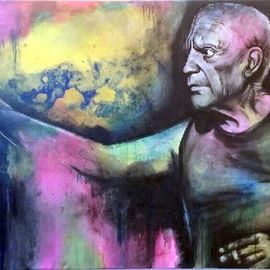
At the beginning of the 20th century, industrialization brought financial prosperity to Germany. Many upper-class citizens and business owners sought proximity to the contemporary art scene and invested in private collections. While some had little interest in avant-garde artists (Impressionism, Expressionism, Cubism), others enjoyed surrounding themselves with these interesting personalities. Paris became the center of contemporary art and the art trade flourished. Pablo Picasso became an icon of the art scene during his lifetime (Lehmann, 2017, p. 30).
Art and business after World War II
After World War II, German companies developed a heightened interest in art, which can be attributed to the strong cultural education of entrepreneurs by Bismarck and the Junker class of the 19th century. Businessmen in Germany were also excluded from political and military associations, leaving them little choice but to devote themselves to art and culture. By promoting art, businesspeople demonstrated their cultural openness. However, the art scene was initially skeptical about this new development.

Art and business today
Far from being mere decoration, attempts are being made to integrate new approaches into everyday business life (Lehmann 2017, p. 223 ff.). In times of social, economic, and cultural change, new ways of thinking are needed. The creativity and pioneering spirit of art can be used for this purpose. Companies are more imaginative than ever when it comes to finding answers to the big questions of our time. Globalization and digitalization call for a rethink and the dissolution of old patterns of thinking (Weber 2010, p. 10 ff.). Art has often proven to be a pioneer in this regard.
Art and business in ancient times
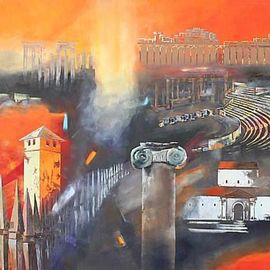
Since ancient times, it has been customary for businesspeople to become patrons of the arts. The Etruscan-Roman financier Gaius Maecenas (c. 70-80 BC) was already known at that time as a patron of the arts and poetry, thus coining the term “patronage,” which is still used today to describe major, but above all selfless, supporters of the arts (Weber, 2010, p. 14).
Art and business in the Renaissance
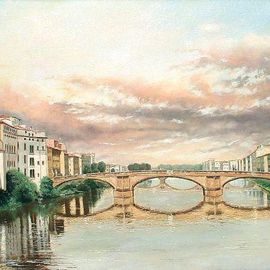
During the Renaissance and Baroque periods, bankers, merchants, princes, royal houses, and the church purchased works of art to decorate their premises. This resulted in the creation of impressive collections. Most of these works were commissioned. The artists were beholden to their patrons and could not prevent their art from being exploited for political, religious, and social purposes (Lehmann, 2017, p. 30).

Art and business in the 19th century
When the nobility ceased to be patrons of the arts due to their disempowerment during the French Revolution in 1789, art began to be marketed by auction houses, art dealers, and gallery owners. These individuals now traded art as a commodity for the first time and acted as intermediaries between buyers and artists (Lehmann, 2017, p. 24ff.). Artists were no longer beholden to the aristocracy or other patrons.
How do the paintings affect the company?
The following list of the effects of art according to Emundt (2003) combines different interpretative approaches to how art in the workplace affects employees: The cognitive function of art is its most important function. It means that art helps us to filter out the essentials from a flood of information. Art selects the most important information from a constantly changing stream in order to reveal the characteristics of objects and situations. The perceptual function of art means that engaging with art can be used as perception training. If too many routines and automatic behaviours creep into our everyday lives, we may lose our ability to perceive things consciously. Art has the ability to awaken people from these routines by allowing them to discover contradictions, shocking or unsettling them by exposing weaknesses, sometimes even by being hurtful.
The emotional impact of art is expressed in the fact that viewing art can trigger emotional responses in people. If positive emotions are addressed, joy, enthusiasm or relaxation can be generated in us, just as negative emotions such as disgust, revulsion or anger can be evoked. Dealing with our own emotions can help us to regain emotional balance and release suppressed tensions or emotions.
The memory effect of art describes how art creates associations that remind us of experiences or insights.
The communicative function of art causes us to engage with the complexity of our perception, as it can help us to recognise the differences between levels of perception.
The inspirational effect of art refers to the addressing of various processing mechanisms that can lead to a person gaining new insights or experiences. By comparing, interpreting and reconnecting the artwork, art can unleash innovative potential and creativity, thereby broadening horizons.
The image effect of art describes the phenomenon that collectors, connoisseurs and lovers of art can signal that they are culturally educated. This alludes to the effect of art as a status symbol.
What are the possible uses for art in the office?
Within a company, art can be used to optimise information processing, facilitate change within the company, or awaken employees from their everyday office routines. Art can evoke desired emotions or release pent-up emotions. This helps employees to reduce stress. Art is used within the company to train human perception on various levels or to promote innovation potential within a company. It stimulates communication among employees and thus helps to improve team cohesion through positive exchange. It beautifies the premises and thus increases well-being in the workplace. As a symbol of status and cultural commitment, art can still help a company enhance its image.
What effect does regularly changing the images have?
It can be assumed that the positive effect of art in the workplace on communication, inspiration, work motivation, teamwork and stress levels among employees is enhanced by regularly changing the art on display. To this end, customers of the Little Van Goghs art service were surveyed in 2020 in the form of a guided expert interview. The experts agreed that changing the art and the variety of different exhibitions by different contemporary artists promotes curiosity among employees, enhances the positive effect of art on communication and thus also has a positive effect on team cohesion. Each time the art is changed, the positive effect of art is stimulated anew, as employees engage with the new art each time it is changed. According to the experts, this regular engagement with ever-changing art can increase work motivation and reduce stress levels among employees. This is because the ever-changing art provides variety and moments of leisure in what is often a very stressful office environment.