
Successful art investment
5 tips for successful art investment
Register now for our next workshop
Next date: Thursday,
November 20, 2025, 10:00 a.m. - 5:00 p.m.
Cost: 250 € (including VAT)
Where?
Little Van Gogh,
Berck-sur-Mer-Str. 20,
53604 Bad Honnef,
Germany
register now
If you have any questions, please send an email to info@littlevangogh.de.
Tip 1: Detailed market knowledge
Especially in times of economic turmoil, the art market proves to be more robust than the financial market. As with the financial market, one should also have detailed market knowledge when purchasing art. Auction results, which are accessible to the public, can serve as a benchmark. In addition, one should consult experts in order to obtain the most accurate estimate of an artwork's value. The following are the appropriate contacts for this:
- Art consultants
- Experts from museums
- Specialised law firms
- Banks active in the art market
- Auction houses
Tip 2: Preserving value
Investors who focus on security should tend to buy works that are considered solid and stable in value. For many experts, an art investment only begins at £50,000 or £60,000 per work. Beginners should rely on experienced advisors. The hip avant-garde is often cheaper, but with a view to value retention and security, it is smarter to invest in works that have already achieved a certain level of recognition and thus a certain price level. Work with experts who are globally positioned: with a well-established network of dealers, gallery owners and auction houses, restorers and appraisers. The chances are good that €50,000 will turn into €200,000 after a few years.
Blue chips: As on the stock market, there are also blue chips on the art market. These are works by internationally renowned artists that sell well over the long term and consistently fetch high prices – Mark Rothko, Jörg Immendorff, Andy Warhol, Jason Pollock and Gerhard Richter, to name but a few. One disadvantage here can be that you can only enter the market with a very high investment.
Tipp: It is important to care for your artwork in order to preserve its value. The following factors are crucial here:
- Proper storage and handling
- Insurance for the artwork
Tip 3: Increase in value
If you would rather start with a smaller investment that has potential for growth, you should focus on artworks with blue-chip potential.
Blue-chip potential: Works by young art students at academies are often considered insider tips. They can be purchased today for £2,000 or £3,000 and may be worth much more in a few years. However, it is also advisable to take a look at online portals. Here, you should pay attention to an outstanding CV. Take a look at our shop. Here you will find many up-and-coming artists with blue-chip potential.
The following questions will guide you to your art investment with blue-chip potential:
- Did the artist study at a renowned university?
- Was the artist a master student of a famous artist?
- Did he receive scholarships or has the artist already won art prizes?
- Is he represented in renowned galleries?
- Are his works represented in public collections or museums?
- Does he have well-known sponsors and patrons?
Watch our video on ‘Pricing works of art’ here. In addition, artists are often ahead of their time and the value of their work is often only recognised after their death, the most famous examples being Vincent Van Gogh and Jason Pollock. Vincent Van Gogh (born 30 March 1853 in Groot-Zundert; died 29 July 1890 in Auvers-sur-Oise): During his lifetime, Vincent Van Gogh had very little financial success with his paintings. He sold only a few pictures, including the painting ‘The Red Vineyard’. It was only after the painter's death that Vincent Van Gogh's masterpieces fetched record sums. His last self-portrait, which he completed in 1889, was sold for a staggering 71 million dollars. Jason Pollock (born 28 January 1912 in Cody, Wyoming; died 11 August 1956 in East Hampton, New York): His painting No. 5, created in 1948, still holds the record as the most expensive painting of all time: it was sold to a private collector in 2006 for the incredible sum of 140 million dollars.
Tip: Works with high potential returns can also turn out to be investment flops. Don't forget to rely on your gut feeling and personal taste. An emotional connection to works of art can compensate for a possible loss in value. In addition, artists are often ahead of their time, and the value of their work is often only recognised after their death. Influencing value appreciation: As a buyer, you naturally have the opportunity to influence the appreciation of the artwork by promoting and supporting the artist. Investors, art lovers and patrons promote artists and their work, creating cultural added value for many generations to come.
Our recommendations for your investment with blue-chip potential

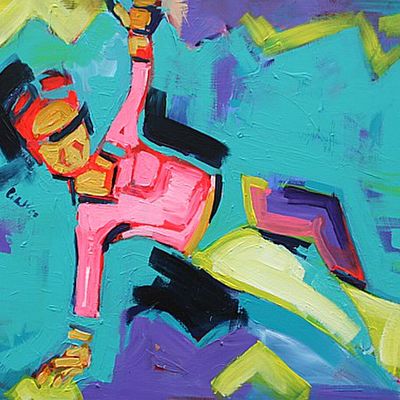
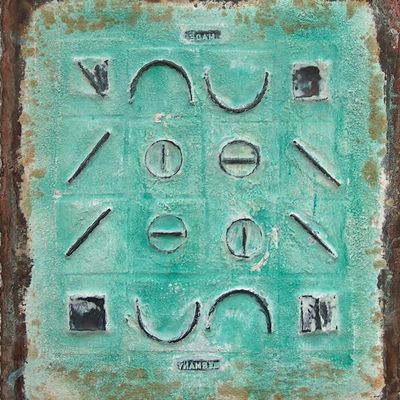


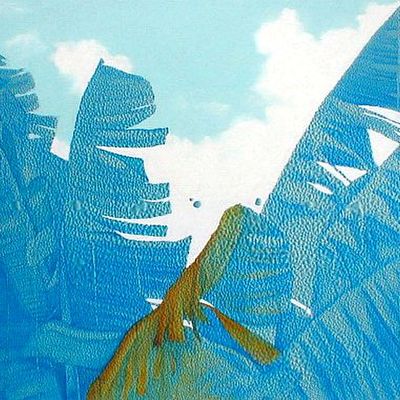
Tip 4: Timing when selling
If you want to sell works from your own collection, timing is everything, just like with shares. Instead of interest, artworks ideally increase in value. Works of art cannot simply be sold at any time for a specific price. In any case, you should be prepared to invest time and patience. If a painting is not sold at auction, it should not be offered again immediately in the same place, as you run the risk of selling the work below its value. Seek the advice of a competent consultant to have your collection appraised
- What is the condition of my works?
- What are the works currently worth?
Tip 5: Remain anonymous when selling high-priced works of art
If you have a Warhol at home, you should not offer it for sale yourself, but always through a third party. This allows owners to remain anonymous. Middlemen can solicit offers and select the right place to sell. If you are looking for an investment with blue-chip potential, then take a look at www.originalkunstkaufen.com.
Our conclusion
Even though the global art market is growing, investing in art places special demands on the buyer. High potential returns also mean high risks. However, art as an alternative investment offers a bonus that other forms of investment do not have: a high emotional and aesthetic factor that cannot be measured in monetary terms. Those who invest in art are not only investing financially, but equally in mindset, culture and education. Nevertheless, the main goal of any investment is to maintain value and, in the best case scenario, to generate a profit. Investing in art can be a capital investment that pays off in more ways than one.